The Two Rule Recovery
Read the Preface
I don’t think anyone knows for certain what their breaking point is. Well, in 2020, I found mine: I had two small strokes, and my words were suddenly gone.
I couldn’t remember my address. My phone number. What anything was called. My short-term memory evaporated, and I couldn’t even recall what I’d just seen or read. I could speak, but wrong; I lived in fog, vague, unable to explain what I wanted or why.
It goes without saying that my writing came to a dead stop.
I’d thought writing was my purpose. I’d thought telling stories, providing escape, was my reason to exist. There I was, regardless, staring at the empty page where my stories should be, weeping.
Without question, this was a low creative point, but here’s the funny thing: it wasn’t the first time I’d landed there.
I have written most of my life. I can’t remember a day when I wasn’t spinning tales, wild amalgamations of things I’d read or seen, developing my own bizarre worlds. Even while attending college for piano performance (not my idea, for the record), I didn’t stop, and spent more time writing stories than I did doing homework. The musical pieces I performed best were always the ones I spun stories to, creating soundtracks in my head.
It may sound strange, in light of this, to state that I’ve also been blocked most of my life. I’ve stared at the blank page (without an excuse like having strokes) and had nothing to write, nothing to put down. That block was horrible.
The co-existence of these two conditions is strangely universal. I like to call us geyser creatives. Sometimes, the art flows, the words flood, and what we create matches the vision in our heads.
And then sometimes, it doesn’t. The imagination shutters. The skills dry up, leaving cracked riverbeds and broken hopes behind, and in those moments, we feel like maybe we were fooling ourselves about this whole artist thing.
Every creative I know has experienced both states. Yay, creating, and boo, blocked were simply the two sides of being an artist. Well, when this health crisis hit, I assumed that eventually my writing would return. It always had in the past. My words would come back to me.
This time, they did not.
Creative, I went months with nothing. Nothing. I went so long without putting anything down that I began to feel like a fraud—like I’d inadvertently lied to anyone I’d ever shown my writing to, like I’d been fooling myself and I’d never been a writer, like my parents were right and all my books were flukes.
Creative block is a cruel thief because it steals the ability to create, but never the need. No matter how long we’ve been blocked, we always yearn for what could-have-been, or might-still-be. Our hearts ache for it, even if we ostensibly “give it up” (whatever that means).
Though we go to sleep weeping into our pillows over our lost art, we still wake knowing we are meant to make it. I grieved my unfinished manuscripts, but my thoughts continually drifted to the stories I needed to tell, no matter how many times I tried to stop hoping. Even though I’d given up, I couldn’t give up.
I know you know this feeling. You are reading this book—and that means, no matter how long you’ve been blocked, you’re not ready to give up, either.
Creative, there is hope for you. I’ve gone from complete block to writing every single day, and I have not been blocked since I applied the principles I am going to teach you. How? What changed? My understanding of creation.
There are only two steps to getting unblocked for good. Two steps to beating your creative block forever. Two steps to being the kind of person who can and will make new things every day.
Those two steps are simple. I didn’t say they’re easy. You’ll have to unlearn bad habits, not just learn good ones. You’ll have to train your thinking with new definitions for old words. You’ll have to fight the mindset that got you into this mess, reevaluating what you value and why. You’ll have to face yourself (your greatest foe), and the challenges that come with a consciously shaped identity.
Creative, you can do this. I know you can. I was able to, and I’m literally not firing on all cylinders.
The Two-Rule Recovery is designed so anyone can take these steps at a pace that works for them. I’m sharing them because I want you creating, too. I want you freed from block. I’m one beggar, showing other beggars where to find a feast.
I want you to have hope.
Come with me now, wrap your hope around you like wings, and I’ll show you how this works.
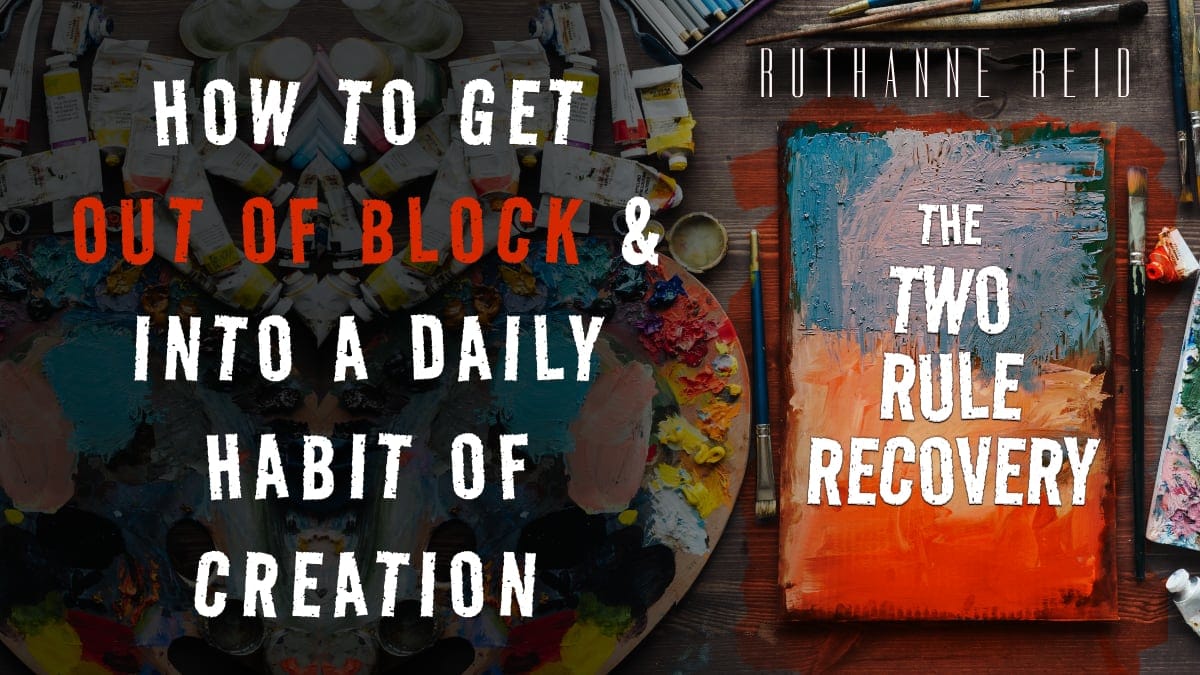
How to get out of block and into a daily habit of creation.
For the majority of my life, every creative I knew existed in one of two states: 1. Inspired and creating! 2. Blocked and silent.
I assumed this was normal until a few years ago, when two small strokes stole all my words. I could no longer wait on the “pattern” to assert itself. My words did not come back on their own, so I faced a choice: give up writing for good, or find a way around.
Creative, this book is the way around.
Involving neuroscience, psychology, and studies from across the globe, the Two-Rule Recovery charts a course that anyone can follow to escape block for good and create a daily habit of creation.
In this book, I’ll break down definitions, identity, and more, tackling many of the issues that left you blocked. Each chapter also includes simple application for you to practice what you’ve learned.
There is hope for you, creative. You are not alone. Join me on this journey, and together, let’s make something new.
Footnotes For the Two Rule Recovery
Chapter One: Permission to Do It Wrong
∗ Goulet-Pelletier JC, Gaudreau P, Cousineau D. Is perfectionism a killer of creative thinking? A test of the model of excellencism and perfectionism. Br J Psychol. 2022 Feb;113(1):176-207. doi: 10.1111/bjop.12530. Epub 2021 Sep 1. PMID: 34472100.
∗ Gao, Y., & Zhang, H. (n.d.). Unconscious processing modulates creative problem solving: Evidence from an electrophysiological study. Gao Y, Zhang H. Unconscious processing modulates creative problem solving: evidence from an electrophysiological study. Conscious Cogn. 2014 May;26:64-73. doi: 10.1016/j.concog.2014.03.001. Epub 2014 Mar 24. PMID: 24674758.
∗ Ritter SM and Dijksterhuis A (2014) Creativity—the unconscious foundations of the incubation period. Front. Hum. Neurosci. 8:215. doi: 10.3389/fnhum.2014.00215, emphasis added. https://www.frontiersin.org/articles/10.3389/fnhum.2014.00215/full.
Chapter Two: Habits
∗ Bonchek, Mark. “Why The Problem With Learning Is Unlearning,” emphasis added. Harvard Business Review, 21 Apr. 2017, hbr.org/2016/11/why-the-problem-with-learning-is-unlearning.
∗ Mendelsohn, Alana. “Creatures of Habit: The Neuroscience of Habit and Purposeful Behavior.” Biological Psychiatry, U.S. National Library of Medicine, 1 June 2019, pmc.ncbi.nlm.nih.gov/articles/PMC6701929/.
∗ Graybiel, Ann M., and Kyle S. Smith. “How The Brain Makes and Breaks Habits.” Scientific American, 21 Jul. 2014, www.scientificamerican.com/article/how-the-brain-makes-and-breaks-habits.
∗ Chen, Quanjing, et al. “Autonomic Flexibility Reflects Learning and Associated Neuroplasticity in Old Age.” Human Brain Mapping, 08 Jun. 2020, doi.org/10.1002/hbm.25034.
Chapter Three: What If?
∗ Byrne, R. M. J. (2016). Counterfactual Thought. Annual Review of Psychology, 67(1), 135–157. https://doi.org/10.1146/annurev-psych-122414-033249.
∗ Tao, W., Zhao, D., Yue, H., Horton, I., Tian, X., Xu, Z., & Sun, H.-J. (2022). The Influence of Growth Mindset on the Mental Health and Life Events of College Students. Frontiers in Psychology, 13. https://doi.org/10.3389/fpsyg.2022.821206.
Chapter Four: Finding Your “Why”
N/A
Chapter Five: Identity
∗ Simons, J. D. (2021). From Identity to Enaction: Identity Behavior Theory. Frontiers in Psychology, 12. https://doi.org/10.3389/fpsyg.2021.679490.
∗ Gupta, Sanjana. “Why Identity Matters and How It Shapes Us.” Verywell Mind. 30 May 2023, www.verywellmind.com/why-identity-matters-and-how-it-shapes-us-7504546.
∗ Why Should You Talk to Yourself? (2021). Psychology Today. https://psychologytoday.com/us/blog/the-clarity/202103/why-should-you-talk-yourself.
Chapter Six: Failure
∗ Mendelsohn AI. Creatures of Habit: The Neuroscience of Habit and Purposeful Behavior. Biol Psychiatry. 2019 Jun 1;85(11):e49-e51. doi: 10.1016/j.biopsych.2019.03.978. PMID: 31122343; PMCID: PMC6701929.
∗ warphotography. “Ira Glass on Storytelling 3.” YouTube, 11 Jul. 2009, www.youtube.com/watch?v=X2wLP0izeJE.
∗ Torre, J. B., & Lieberman, M. D. (2018). Putting Feelings Into Words: Affect Labeling as Implicit Emotion Regulation. Emotion Review, 10(2), 116-124. https://doi.org/10.1177/1754073917742706 (Original work published 2018)
Chapter Seven: Editing
∗ Diane. (2015, November 10). Dominick Dunne: Before He Was A Journalist – Diane Capri. Diane Capri – Licensed to Thrill. https://dianecapri.com/2015/11/dominick-dunne-before-he-was-a-journalist/
∗ Jarmolowicz, D. P., Bickel, W. K., Sofis, M. J., Hatz, L. E., & Mueller, E. T. (2016). Sunk costs, psychological symptomology, and help seeking. SpringerPlus, 5(1). https://doi.org/10.1186/s40064-016-3402-z
Chapter Eight: Imposter Syndrome
∗ Huecker MR, Shreffler J, McKeny PT, et al. Imposter Phenomenon, emphasis added. [Updated 2023 Jul 31]. In: StatPearls [Internet]. Treasure Island (FL): StatPearls Publishing; 2025 Jan-. Available from: https://www.ncbi.nlm.nih.gov/books/NBK585058/
∗ Lewis, T. (2015, September 13). Robert Pattinson: “I’m definitely very confused.” The Guardian; The Guardian. https://www.theguardian.com/film/2015/sep/13/robert-pattinson-james-dean-film
∗ Feigofsky, Suzanne. “Imposter Syndrome.” HeartRhythm Case Reports, vol. 8, no. 12, 1 Dec. 2022, pp. 861–862, www.heartrhythmcasereports.com/article/S2214-0271(22)00221-4/fulltext, https://doi.org/10.1016/j.hrcr.2022.11.001.
Chapter Nine: Expectations
∗ Höpfner J and Keith N (2021) Goal Missed, Self Hit: Goal-Setting, Goal-Failure, and Their Affective, Motivational, and Behavioral Consequences. Front. Psychol. 12:704790. doi: 10.3389/fpsyg.2021.704790
∗ Jones, N. P., Papadakis, A. A., Orr, C. A., & Strauman, T. J. (2013). Cognitive Processes in Response to Goal Failure: A Study of Ruminative Thought and its Affective Consequences. Journal of Social and Clinical Psychology, 32(5), 482–503. https://doi.org/10.1521/jscp.2013.32.5.482
∗ Wang, W., Li, J., Sun, G. et al. Achievement goals and life satisfaction: the mediating role of perception of successful agency and the moderating role of emotion reappraisal.Psicol. Refl. Crít. 30, 25 (2017). https://doi.org/10.1186/s41155-017-0078-4
Chapter Ten: Filling the Well
∗ Filling the Well | Julia Cameron Live. (n.d.). Juliacameronlive.com. https://juliacameronlive.com/2012/08/17/filling-the-well/
∗ White, J. (2016). Talking on the water : conversations about nature and creativity., emphasis mine. Trinity University Press.
∗ Magsamen S. Your Brain on Art: The Case for Neuroaesthetics. Cerebrum. 2019 Jul 1;2019:cer-07-19. PMID: 32206171; PMCID: PMC7075503.
∗ Kumar, Vinay; Pavitra, KS1; Bhattacharya, Rahul2. Creative pursuits for mental health and well-being. Indian Journal of Psychiatry 66(Suppl 2):p S283-S303, January 2024. | DOI: 10.4103/indianjpsychiatry.indianjpsychiatry_781_23
∗ Cameron, J. (2002). The Artist’s Way : 25th Anniversary Edition, p. 36. Penguin Publishing Group.
Chapter Eleven: Day One
N/A
Chapter Twelve: Regret
∗ Rutledge JA, Williams JD and Barlow MA (2024) The relationship between life regrets and well-being: a systematic review, emphasis added. Front. Psychol. 15:1515373. doi: 10.3389/fpsyg.2024.1515373
∗ Roese NJ, Summerville A. What we regret most… and why. Pers Soc Psychol Bull. 2005 Sep;31(9):1273-85. doi: 10.1177/0146167205274693. PMID: 16055646; PMCID: PMC2394712.
∗ Rutledge JA, Williams JD, Barlow MA. The relationship between life regrets and well-being: a systematic review, emphasis added. Front Psychol. 2024 Dec 19;15:1515373. doi: 10.3389/fpsyg.2024.1515373. PMID: 39749269; PMCID: PMC11694412.
∗ Muhammad Tuhin. (2025, June 23). The Neuroscience of Regret: Why It Haunts Us. Science News Today. https://www.sciencenewstoday.org/the-neuroscience-of-regret-why-it-haunts-us
∗ Gao H, Zhang Y, Wang F, Xu Y, Hong YY, Jiang J. Regret causes ego-depletion and finding benefits in the regrettable events alleviates ego-depletion. J Gen Psychol. 2014;141(3):169-206. doi: 10.1080/00221309.2014.884053. PMID: 24940811.
∗ Roese NJ, Summerville A. What we regret most… and why. Pers Soc Psychol Bull. 2005 Sep;31(9):1273-85. doi: 10.1177/0146167205274693. PMID: 16055646; PMCID: PMC2394712.
∗ Reeck C, LaBar KS. Reining in regret: emotion regulation modulates regret in decision making. Cogn Emot. 2024 Dec;38(8):1368-1375. doi: 10.1080/02699931.2024.2357847. Epub 2024 Jun 4. PMID: 38832896.
∗ No regrets: New Temple study shows how to reimagine past feelings of regret. (2024). Office of the Vice President for Research. https://research.temple.edu/news/2024/08/no-regrets-new-temple-study-shows-how-reimagine-past-feelings-regret
Chapter Thirteen: On Burnout
∗ Leddy, PA-C, MMSc, M. (2022). Thriving, Not Just Surviving: Recognizing Burnout and Simple Tips to Start Feeling Better. Journal of the Advanced Practitioner in Oncology, 13(3), 209–212. https://doi.org/10.6004/jadpro.2022.13.3.5
∗ Edú-Valsania, S., Laguía, A., & Moriano, J. A. (2022). Burnout: A Review of Theory and Measurement. International Journal of Environmental Research and Public Health, 19(3), 1780. https://doi.org/10.3390/ijerph19031780
∗ Edú-Valsania S, Laguía A, Moriano JA. Burnout: A Review of Theory and Measurement. Int J Environ Res Public Health. 2022 Feb 4;19(3):1780. doi: 10.3390/ijerph19031780. PMID: 35162802; PMCID: PMC8834764.
∗ Abedini, N. C., Stack, S. W., Goodman, J. L., & Steinberg, K. P. (2018). “It’s Not Just Time Off”: A Framework for Understanding Factors Promoting Recovery From Burnout Among Internal Medicine Residents. Journal of Graduate Medical Education, 10(1), 26–32. https://doi.org/10.4300/jgme-d-17-00440.1
∗ Leddy, PA-C, MMSc, M. (2022). Thriving, Not Just Surviving: Recognizing Burnout and Simple Tips to Start Feeling Better. Journal of the Advanced Practitioner in Oncology, 13(3), 209–212. https://doi.org/10.6004/jadpro.2022.13.3.5
∗ Aronsson, I., Neely, A. S., Boraxbekk, C.-J., Eskilsson, T., & Gavelin, H. M. (2024). “Recovery activities are needed every step of the way”—exploring the process of long-term recovery in people previously diagnosed with exhaustion disorder. BMC Psychology, 12(1). https://doi.org/10.1186/s40359-024-01756-z
Chapter Fourteen: Excuses
N/A
Chapter Fifteen: A Note on Generative AI
∗ Dergaa I, Ben Saad H, Glenn JM, Amamou B, Ben Aissa M, Guelmami N, Fekih-Romdhane F and Chamari K (2024) From tools to threats: a reflection on the impact of artificial-intelligence chatbots on cognitive health. Front. Psychol. 15:1259845. doi: 10.3389/fpsyg.2024.1259845
∗ Sternberg, R. J. (2024). Do Not Worry That Generative AI May Compromise Human Creativity or Intelligence in the Future: It Already Has. Journal of Intelligence, 12(7), 69–69. https://doi.org/10.3390/jintelligence12070069
Chapter Sixteen: What Comes Next
∗ Award-winning author J.M. Frey, personal conversation in May, 2024
∗ Martino, J., Pegg, J., & Frates, E. P. (2015). The Connection Prescription: Using the Power of Social Interactions and the Deep Desire for Connectedness to Empower Health and Wellness. American Journal of Lifestyle Medicine, 11(6), 466–475. https://doi.org/10.1177/155982761560878888
Chapter Seventeen: The Two-Rule Recovery Manifesto
∗ Merriam-Webster. (n.d.). Manifesto. In Merriam-Webster.com dictionary. Retrieved September 18, 2025, from https://www.merriam-webster.com/dictionary/manifesto